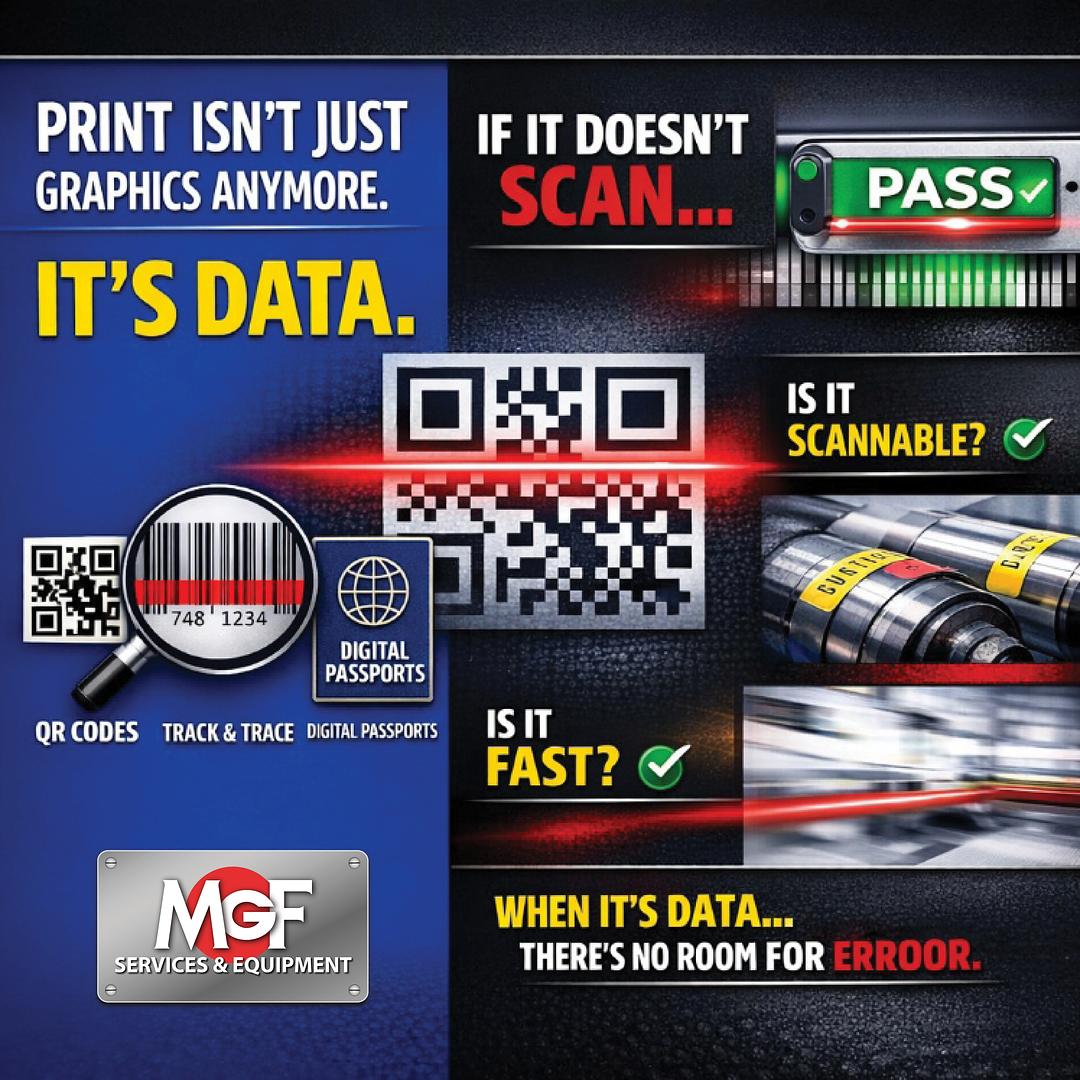
Print used to be about how it looked. Now it’s also about whether it works. If a code doesn’t scan, the printed piece doesn’t do what it was intended to do. And most of the time, that failure doesn’t show up right away—it shows up later, during finishing, downstream, or in the customer’s hands.
That’s the shift. Print isn’t just output anymore. It’s part of a larger system.
What Changed
Packaging and print are now expected to do more than communicate visually. They connect to digital content, support traceability, and verify product information. In some cases, they also need to meet retailer, operational, or compliance requirements.
That means it’s not just about looking right. It has to perform consistently.
Where It Breaks Down
When something doesn’t scan, the first instinct is to check the file, the artwork, or the data. And sometimes that’s the right place to start.
But often, the problem begins in the process. Small shifts in registration, impression, substrate behavior, or finishing can affect scan performance—even when the piece still looks acceptable to the eye.
The Real Issue
A lot of equipment still runs, produces output, and appears to be doing its job. But “running” and “running consistently” are not the same thing.
That distinction matters more now because functional print is less forgiving. Slight misregistration, minor print variation, surface inconsistency, or distortion introduced during coating, laminating, or slitting may not stop production, but they can affect whether a barcode, QR code, or other scannable element performs reliably.
Where Problems Show Up
Most failures do not appear where they begin. They emerge later in the workflow.
On press: Subtle variation may be difficult to detect during production.
During finishing: Coating, laminating, and slitting can introduce distortion that affects scan performance.
Downstream: Handling and real-world use often expose problems that were not visible earlier.
By that point, the issue may appear to be a print defect. In reality, it is often a consistency problem across the process.
Quick Check
If you are producing scannable or data-driven print, ask three questions: Does it scan at full speed? Does it scan after finishing? Does performance hold across the entire run?
If the answer is “not always,” the issue is rarely random. It usually indicates that part of the process is not holding consistently.
Final Thought
The industry is not slowing down. It is becoming less forgiving. The question is no longer just, “Is it running?” It is, “Is it consistent under today’s demands?”