Why Lost Production Capacity Often Costs More Than Equipment Failures
Every manufacturing operation invests significant resources into equipment. Presses, slitters, rewinders, laminators, rollers, cylinders, and hundreds of supporting components help keep production moving and customers satisfied.
Because of those investments, equipment often becomes the primary focus when discussing operational costs.
But there is a larger question many organizations overlook:
What is the cost when that equipment stops producing?
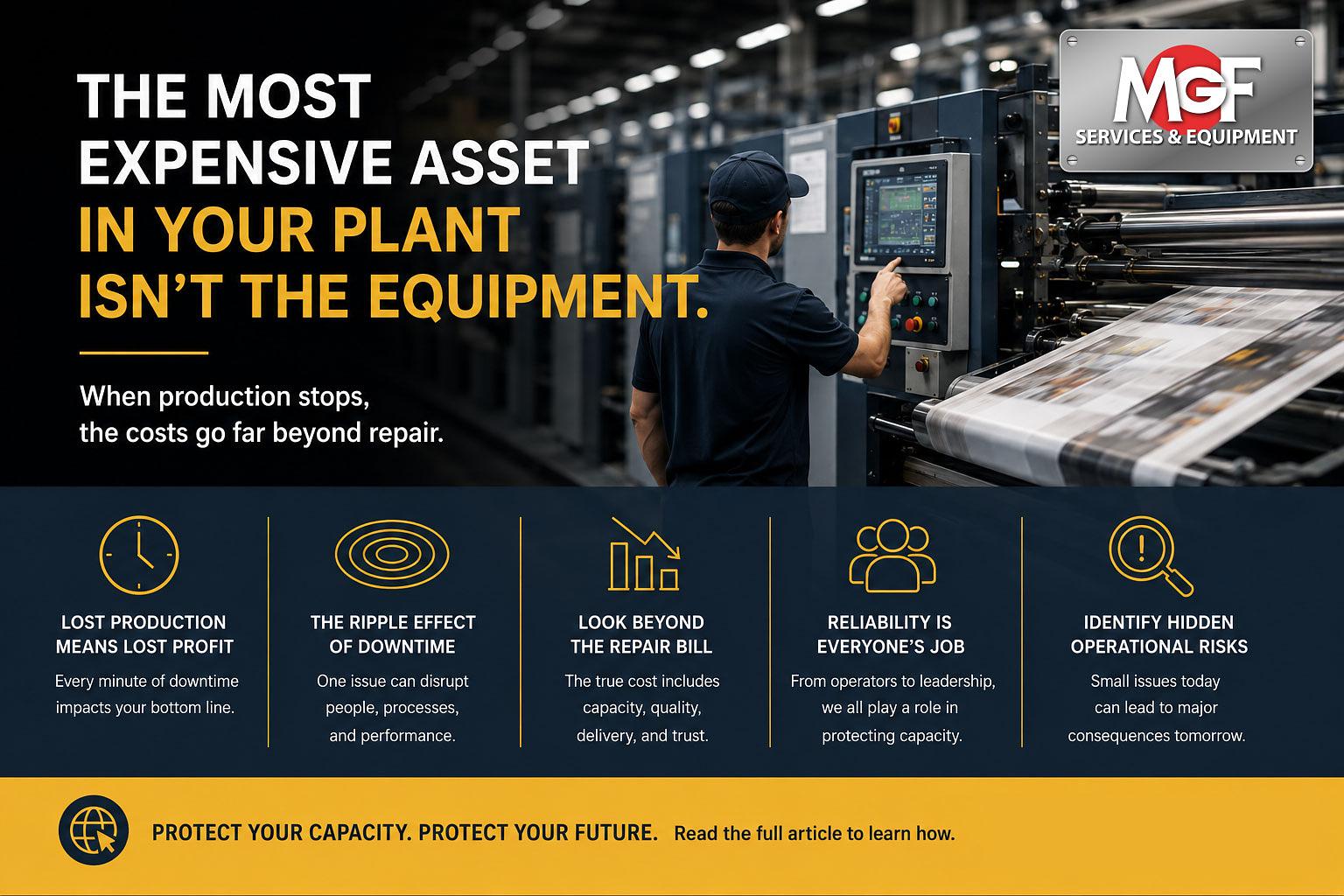
In many cases, the most valuable asset in a facility is not the equipment itself.
It is the production capacity the equipment creates.
Looking Beyond the Repair Bill
When a critical component fails, most discussions begin with the immediate cost.
Can it be repaired?
Should it be rebuilt?
Does it need replacement?
While those are important questions, they rarely tell the entire story.
A production disruption can affect nearly every area of the business:
- Production schedules
- Labor efficiency
- Customer deliveries
- Material utilization
- Overtime expenses
- Freight costs
- Customer satisfaction
The repair cost may be visible on an invoice.
The operational impact often spreads much further.
The Ripple Effect of Downtime
An unexpected shutdown rarely affects only one machine.
Production plans are adjusted.
Jobs are rescheduled.
Operators are reassigned.
Customer service teams begin responding to questions about deliveries.
Management attention shifts from strategic goals to immediate problem-solving.
What starts as a maintenance issue quickly becomes an operational challenge.
In many facilities, the financial impact of lost production can exceed the actual cost of the failed component.
Reliability Is Everyone's Responsibility
Equipment reliability is often viewed as a maintenance function.
The reality is much broader.
For Production Supervisors
Reliable equipment creates predictable schedules, consistent product quality, and fewer disruptions on the production floor.
For Maintenance Managers
Reliability allows resources to be planned effectively, reduces emergency repairs, and supports long-term equipment performance.
For Plant Managers
Reliable equipment helps maintain production targets, improve efficiency, and support customer commitments.
For Executive Leadership
Reliability protects production capacity, customer relationships, profitability, and long-term business performance.
Today's most successful operations understand that reliability is not simply a maintenance metric.
It is a business strategy.
Identifying Hidden Operational Risks
The strongest operations are not always those with the newest equipment.
More often, they are the organizations that understand their operational risks before a failure occurs.
Ask yourself:
- Which assets would have the greatest impact on production if they failed tomorrow?
- Which components have become recurring maintenance concerns?
- Where are the production bottlenecks in your operation?
- Which components would be difficult or time-consuming to replace?
- Are there areas where downtime risk has gone unnoticed simply because equipment is still running?
These questions often reveal opportunities to improve reliability before a disruption occurs.
Preparing for the Second Half of the Year
As we move into the second half of the year, many organizations begin focusing on production goals, customer commitments, and year-end performance targets.
This is the ideal time to look beyond maintenance costs and evaluate operational risk.
The objective is not simply to reduce maintenance expenses.
The objective is to protect production capacity, maintain operational stability, and support long-term profitability.
Because when equipment stops unexpectedly, the greatest loss is often not the value of the component.
It's the value of the production capacity that disappears with it.
Final Thought
The companies that perform best over the long term are rarely the ones that react fastest to failures.
They are the ones that identify risks before those failures occur.
By understanding which assets are most critical to production and addressing vulnerabilities before they become emergencies, organizations place themselves in a stronger position to improve uptime, serve customers more effectively, and achieve their business objectives.
In today's competitive manufacturing environment, protecting production capacity may be one of the most important investments an organization can make.
Concerned About a Critical Piece of Equipment?
I invite you to reach out to MGF Services & Equipment to discuss assessing equipment condition, identifying hidden operational risks, and keeping production moving.