
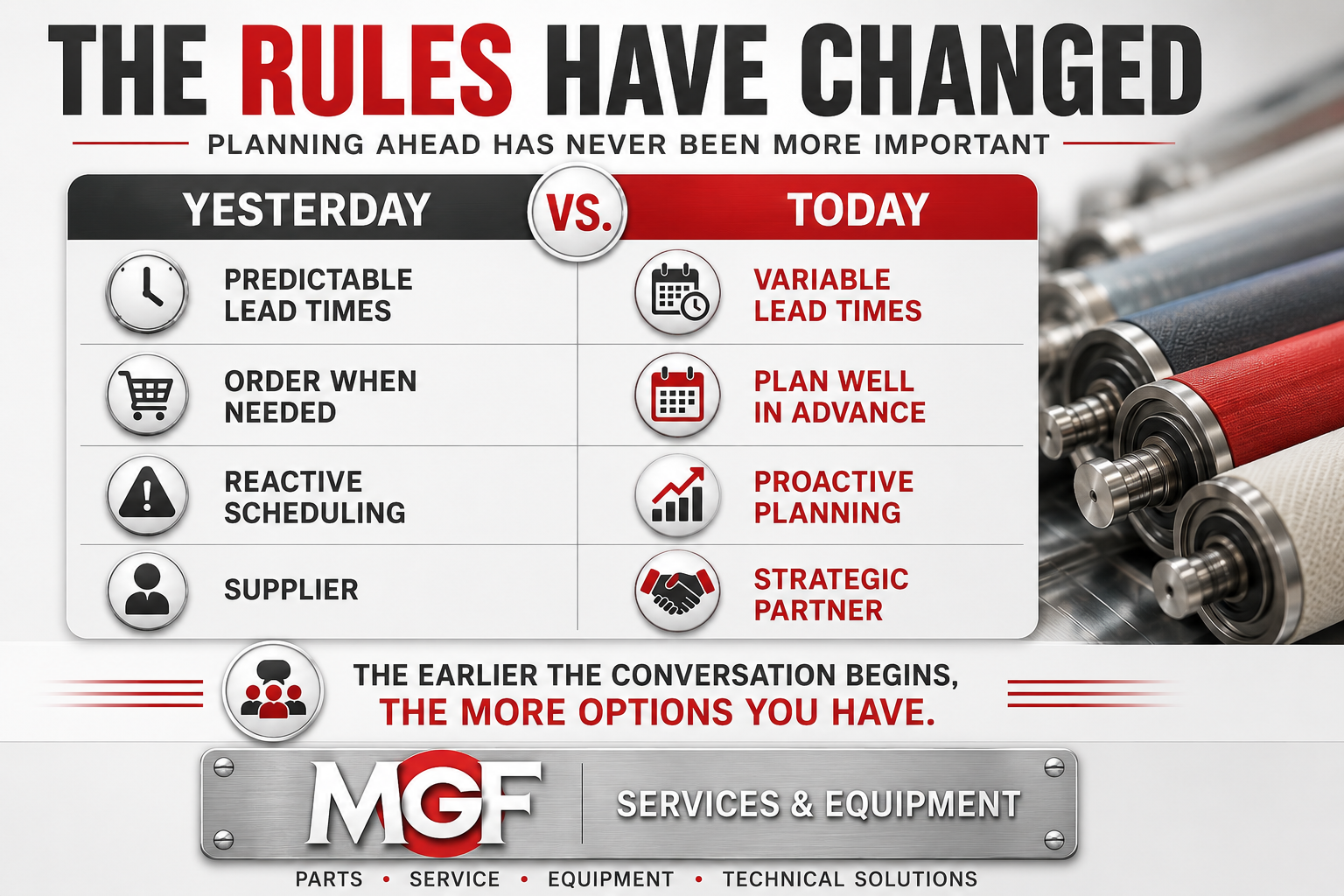
How longer lead times, material shortages, and supply chain uncertainty are changing maintenance planning.
Manufacturers used to plan maintenance around fairly predictable timelines. If a roller needed recovering, a component required refurbishment, or replacement parts were ordered, teams could usually estimate when the work would be complete and schedule production with confidence.
If a roller needed recovering, a component required refurbishment, or replacement parts were ordered, there was a reasonable expectation of when the work would be completed. Maintenance schedules were built around those timelines, allowing production to move forward with confidence.
Today, that environment has changed.
Today, those timelines are harder to predict. Materials that were once readily available can now be delayed for weeks—or even months. Specialty coatings, engineered polymers, nylon coverings, rubber compounds, bearings, and other critical materials often take longer to source, which can affect every stage of a repair or refurbishment project.
This is not a problem tied to one supplier, one material, or one industry. It is part of a broader shift happening throughout the global manufacturing supply chain.
The Domino Effect
Most customers see only the completed repair.
What they don't see is everything that must happen before that repair can begin.
A typical refurbishment project may depend on several moving parts working together:
• Specialty raw materials
• Overseas manufacturing
• Transportation and shipping schedules
• Production capacity
• Skilled labor availability
• Vendor scheduling
• Final inspection and quality control
When just one part of that process experiences a delay, the entire schedule shifts.
One supplier waits for material. Another has to reschedule production. Transportation changes, labor schedules move, and a project that once required four weeks may now require eight—or longer.
Not because companies are working slower, but because every step depends on the one before it.
A Real-World Example
Recently, one of our long-time supplier partners shared an example that reflects what many manufacturers are facing today.
After sourcing a specialty material from Europe for decades, they were informed that shipments would be delayed again because production was being allocated first to existing regional demand.
After already waiting months, another six-week delay was added before manufacturing could even begin.
Stories like this are becoming increasingly common throughout our industry.
This Isn't About Working Slower
One of the biggest misconceptions is that longer lead times mean manufacturers have become less efficient.
In reality, most companies are working harder than ever.
The challenge is simple:
You cannot install materials that haven't arrived.
You cannot apply specialty coatings that are unavailable.
You cannot complete repairs without the necessary components.
When raw materials are delayed, every business downstream feels the impact.
Planning Is No Longer Optional
One of the most valuable things manufacturers can do today is begin the planning process earlier than they may have in the past.
Waiting until equipment fails often leaves very few options.
Instead, consider:
• Scheduling refurbishments before peak production seasons.
• Inspecting critical rollers and components earlier.
• Maintaining spare components whenever practical.
• Sharing upcoming production schedules with your suppliers.
• Allowing additional time for specialty materials.
Companies that plan ahead have more flexibility, fewer surprises, and less unplanned downtime.
Communication Is More Important Than Ever
At MGF Services & Equipment, we believe communication is just as important as the repair itself.
While we can't control global supply chains or raw material availability, we can keep our customers informed, provide realistic lead times, and work closely with our supplier network to develop the best possible solutions.
Our goal isn't simply to repair components.
Our goal is to help our customers plan with confidence.
Final Thoughts
Manufacturing has always required planning.
Today's environment simply requires more of it.
The companies that recognize these changing conditions—and adjust their maintenance strategies accordingly—will be better positioned to reduce downtime, avoid production disruptions, and maintain a competitive advantage.
Planning ahead isn't just good practice anymore. It's become a competitive advantage.
Thank you for taking the time to read our insights. If you're evaluating an upcoming refurbishment project, replacement component, or equipment service, we encourage you to start the conversation early. MGF Services & Equipment is here to help you plan ahead, minimize downtime, and keep your operation moving forward.
MGF Services & Equipment
Your Trusted Partner for Parts, Service, Equipment & Technical Solutions