Last week, while visiting commercial print, direct mail, catalog, insert, self-mailer, and packaging operations, one question kept coming up:
How do we improve productivity, protect profitability, and get more out of equipment that is still doing its job?
It is a question more companies are asking as they face increasing labor costs, tighter production schedules, and growing pressure to do more with existing resources. For many operations, the answer isn't necessarily a larger capital investment. It may be a smarter look at where time, labor, and product movement are being lost within the existing workflow.
In many cases, the greatest opportunity isn't replacing an entire production line. It's identifying where the process breaks down—and strategically integrating new technology with equipment that still has productive life. Sometimes, the opportunity is sitting right between the equipment you already own: where one process ends, another begins, and labor and handling fill the gap.
Looking Beyond Individual Machines
Too often, equipment decisions are made one machine at a time. A press is evaluated separately from finishing. Finishing is evaluated separately from material handling. Material handling is evaluated separately from mailing or packaging. But your customers don't purchase individual production steps.
They purchase completed products delivered accurately and on time.
That's why it makes sense to step back and look at the operation as a complete workflow rather than simply a collection of individual machines. The question is no longer simply:
"Do I need a new machine?"
A better question may be:
"How can I make my entire operation flow more efficiently?"
That shift in thinking matters because the hidden cost in many operations isn't always found in one machine. It's often found in the movement between machines.
Every Touchpoint Has a Cost
Whether you're producing direct mail, catalogs, inserts, self-mailers, commercial print, or packaging, every additional touchpoint adds cost. Products are moved. Materials are staged. Stacks are transferred between departments. Work waits for the next operation. Operators spend valuable time handling products instead of producing them.
Individually, these activities may seem insignificant. Collectively, these hidden handoffs can have a significant impact on labor costs, throughput, turnaround times, capacity, and overall profitability.
One of the simplest exercises is to follow a job through your facility from press to finished product.
- How many times is it touched?
- How many times is it moved, staged, restacked, or transported to another area?
- How long does it wait before the next operation begins?
- How much operator time is spent moving the product rather than producing it?
Not every touch can—or should—be eliminated. But every touch should have a reason. Reducing even a few unnecessary handoffs can create measurable improvements throughout the operation.
Integration Versus Replacement
Some of the most effective equipment projects are not complete line replacements. Instead, companies can identify specific production bottlenecks and strategically integrate modern finishing technology into existing workflows.
Depending on the application, that could mean bringing cutting, die cutting, gluing, coating, perforating, folding, mailing, delivery, or other finishing processes closer together rather than continuing to perform them as isolated operations. The objective isn't automation simply for the sake of automation.
The objective is to eliminate unnecessary steps and make the entire production process work better. When the right finishing technology is integrated into an existing operation, it can create opportunities to:
- Reduce labor requirements
- Minimize unnecessary handling
- Increase throughput
- Improve turnaround times
- Eliminate production bottlenecks
- Improve consistency
- Increase capacity without proportionally increasing labor
Extend the productive life and value of existing equipment
In many cases, the return on investment comes from helping the entire workflow perform better, not from replacing every piece of equipment in it.
Focus on the Process—and the Cost of Doing Nothing
One of the biggest mistakes a company can make is focusing solely on the purchase price of a new piece of equipment. The more important question may be: What is the cost of maintaining an inefficient process?
A workflow that requires excessive handling, multiple staging points, unnecessary labor, and work-in-process waiting between operations may quietly be costing far more than anyone realizes. And those costs don't always appear neatly on one line of a financial statement.
They can show up as overtime, additional operators, slower turnaround, lost capacity, excessive work-in-process, scheduling difficulties, or the inability to take on additional work. Before evaluating the next capital purchase, consider a few basic questions:
- Where does the job slow down?
- Where is labor concentrated?
- Where does product sit waiting for the next operation?
- How many times is the product being moved or restaged?
- Which operation is determining the speed of the entire job?
- Could two or more separate processes be consolidated?
And perhaps most importantly:
Could an existing asset become significantly more productive if another process were integrated with it?
Those questions can reveal opportunities that aren't always obvious when equipment is evaluated one machine at a time.
Protecting the Investment You Already Made
There is another side to this discussion that is sometimes overlooked. Companies have already made substantial investments in presses and production equipment that may still be performing very well.
If that equipment continues to produce a quality product reliably, replacing it simply because newer technology exists may not always be the best use of capital. The better investment may be to address what happens before, after, or between those existing assets.
Strategically adding finishing capability, automation, or material-handling solutions can allow a company to retain equipment that still has value while improving the efficiency of the overall production process. That's the difference between simply buying equipment and investing in workflow.
A Better Way Forward
The most profitable operations aren't necessarily the ones with the newest equipment. They're often the ones that understand their workflow and make smart, strategic improvements where those improvements will have the greatest impact.
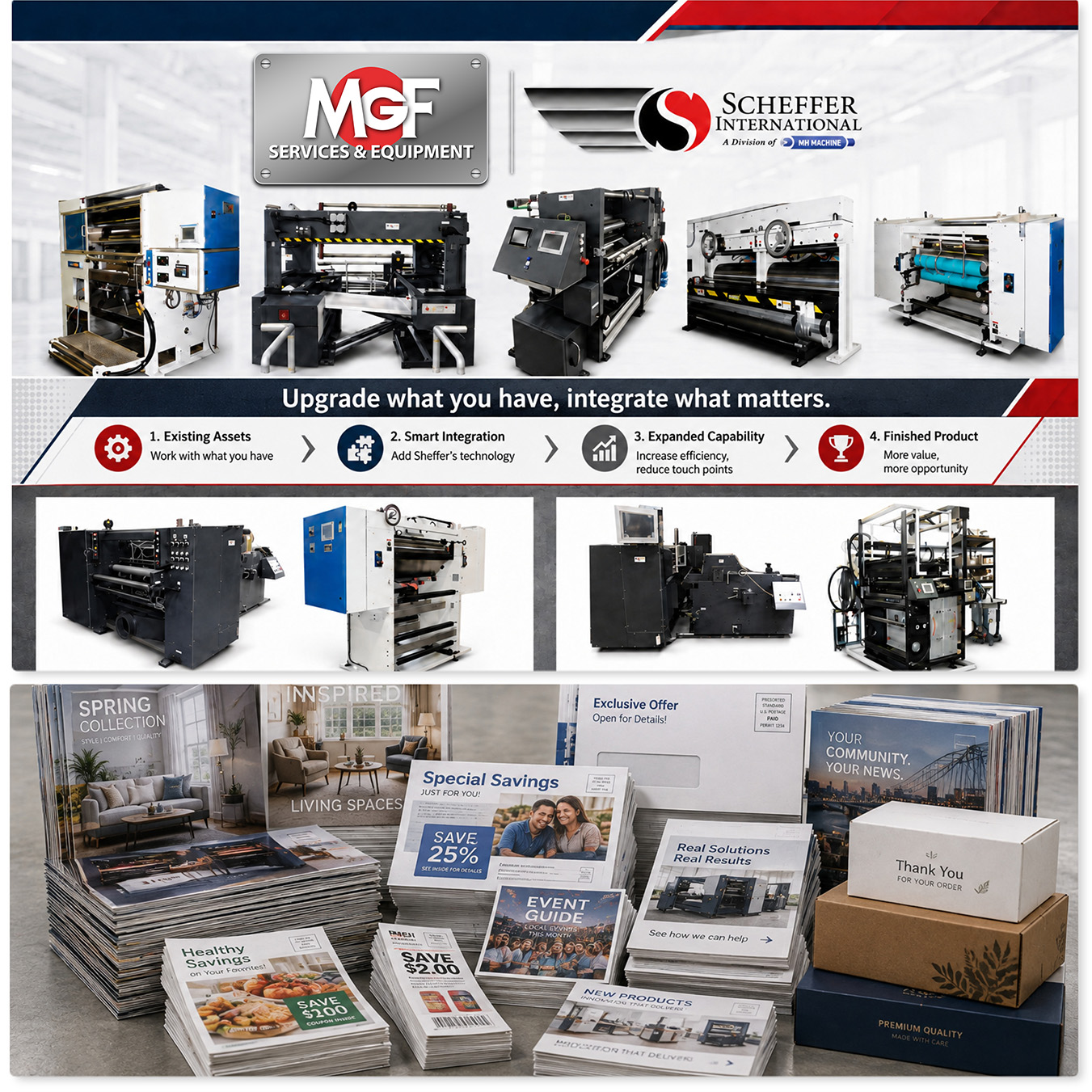
At MGF Services, as an authorized representative for Scheffer International, we work with printers and producers to look beyond an individual piece of equipment and evaluate opportunities within the overall production process.
- Sometimes that means adding new finishing capabilities.
- Sometimes it means automating an existing process.
- Sometimes it means consolidating multiple production steps.
And sometimes it means connecting systems that were never originally designed to work together. The objective remains the same:
Reduce touches. Improve flow. Increase profitability.
Before making your next capital investment, take a closer look at your workflow—from the beginning of the job all the way through the finished product. You may discover that the smartest investment is not a new production line at all. It is making your current operation perform more like one.
If you are exploring ways to consolidate your production process, improve throughput, reduce labor dependency, or integrate finishing solutions into your existing operation, MGF Services and Scheffer International can help evaluate where the greatest opportunities may be hiding.
Sometimes a fresh perspective is all it takes to see what's been there all along.
Mona Friedl
President, MGF Services