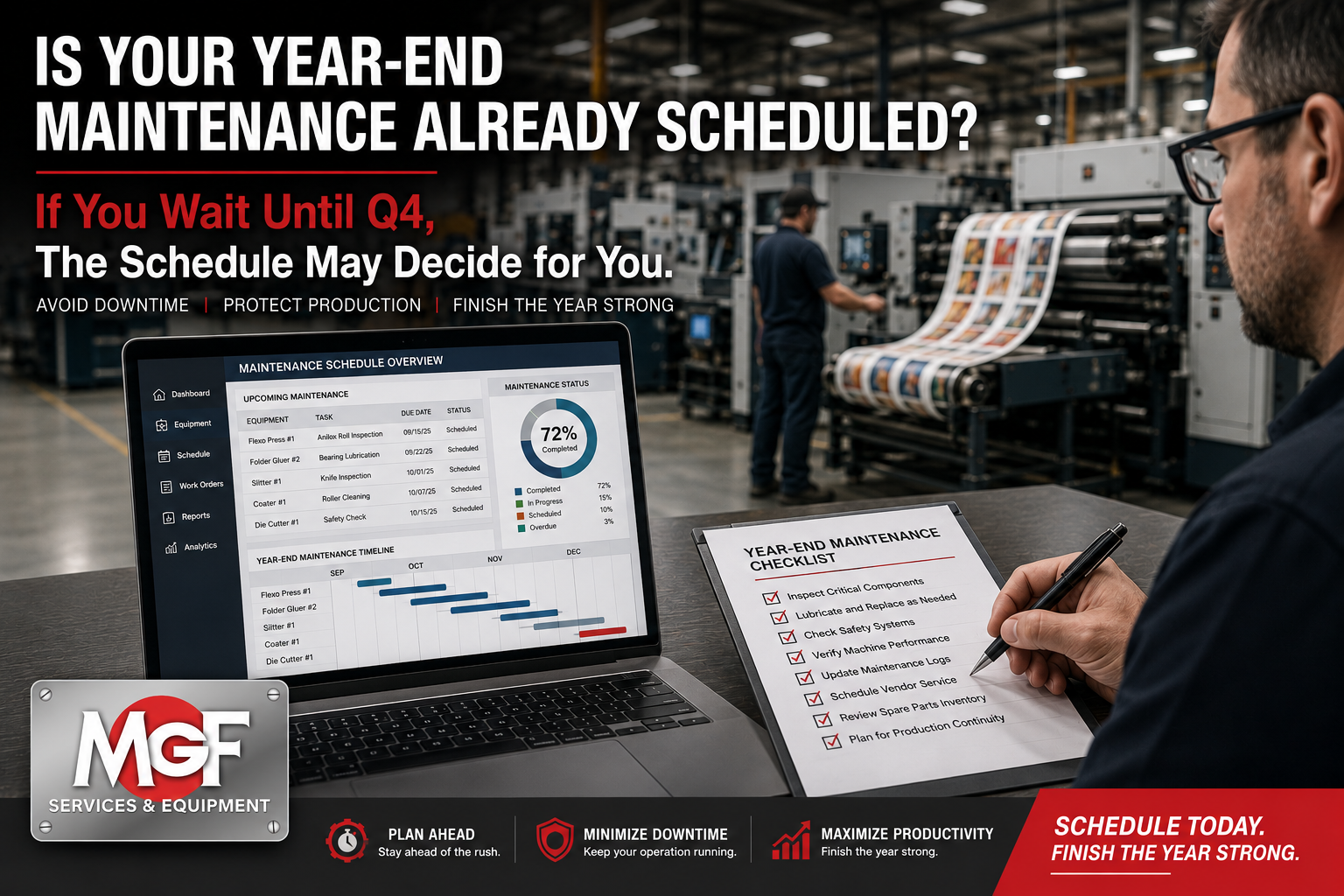
If you wait until Q4, the schedule may decide for you.
As we move through the second half of the year, printing, packaging and converting operations should take a closer look at equipment condition, known wear points and year-end maintenance requirements before shutdown windows begin filling up.
Projects involving rebuilds, repairs, replacement rollers, specialty coatings, reverse-engineered components and equipment upgrades rarely begin when the machine comes down. The planning starts much earlier because lead time matters.
Material availability, global supply-chain conditions, specialty coating capacity, outside processing, engineering requirements, transportation and experienced technicians can all affect how quickly a maintenance project can be completed.
Waiting until a scheduled shutdown is approaching to begin that process can leave a plant with very few options.
Start With a Practical Equipment Review
The first question should not simply be whether the machine is still running. A better question is whether the equipment is likely to require attention over the next six to twelve months.
Maintenance and production teams should review equipment history, recurring problems and known wear points, especially components that have required repeated adjustments, temporary repairs or increased operator attention.
For printing, packaging and converting equipment, that review should focus on the components most likely to affect uptime, quality and lead time, including rollers, cylinders, shafts, journals, bearing areas, gears, drive components, ink and coating systems, pneumatic and hydraulic systems, electrical controls, safety systems and obsolete components.
Rollers and Cylinders Deserve Particular Attention
Rollers and cylinders are critical throughout printing, packaging and converting equipment. Their condition can directly affect product quality, machine performance and planned downtime.
A roller that appears serviceable during a quick visual inspection may still have issues with its surface, coating, journals, bearings, concentricity or dimensional tolerances.
Chrome-plated rollers and cylinders should be inspected for scoring, wear, corrosion, pitting, flaking or deterioration of the chrome surface. When the base material, core and journals are sound, stripping, repairing, regrinding and rechroming may be a practical alternative to complete replacement.
Ceramic-coated rollers should be evaluated for damage, scoring, contamination or coating deterioration that may affect performance. Depending on the application and condition of the roller, recoating or manufacturing a replacement may need to be considered.
Anilox rollers and sleeves should be reviewed for physical damage, cell condition, wear, plugging and whether the roller continues to deliver the volume required for the application.
Nylon, commonly known as Rilsan®, metering and ink rollers should be inspected for surface wear, scoring or grooving, dimensional changes, journal and bearing condition, runout and concentricity. A roller may continue to operate while gradually losing the surface condition or dimensional accuracy required for consistent performance.
Rubber-covered and specialty rollers should be inspected for hardness changes, cracking, glazing, swelling, surface damage and dimensional condition. Journals, bearing fits, shaft condition, runout, concentricity and the base core can determine whether rebuilding is technically and economically practical.
Rebuild, Recoat or Manufacture New?
One of the most important maintenance decisions is whether a worn roller or component should be repaired, rebuilt, recoated or replaced. The right answer depends on the condition of the core, journals, bearing areas, surface requirements, lead time and long-term value of the repair.
Useful specifications may include overall length, face length, outside diameter, journal dimensions, bearing fits, material, hardness, surface finish, runout, concentricity and applicable chrome, ceramic, anilox, nylon/Rilsan or rubber-covering requirements.
When OEM drawings are unavailable, an existing component may have to be measured and reverse engineered to manufacture a replacement.
That takes time, which is why these projects should be identified before the equipment is scheduled to come down.
Don't Let a Roller Shut Down an Entire Line
A relatively small component can stop a very expensive machine. A damaged roller, failed bearing, worn journal or obsolete component may represent only a fraction of the value of the press or packaging line, but if it is essential to operation and no spare is available, production can stop.
This is an excellent time to review critical spare-parts inventory and ask a simple question: if this roller or component failed tomorrow, would you have a spare, a drawing, a qualified repair path and a realistic lead time?
Finding those answers now is considerably easier than finding them while a production line is down.
Preventive Maintenance Is More Than Lubrication
Preventive maintenance should also be used as an opportunity to evaluate overall equipment performance, especially changes that may have occurred gradually and become accepted as normal.
Correcting several smaller issues during one planned maintenance window can be far more economical than addressing them individually after failures occur.
Consider Upgrades While the Equipment Is Already Down
A planned shutdown can also provide an opportunity to complete upgrades that have been postponed during normal production. Older equipment may still be mechanically sound but benefit from improvements to controls, drives, guarding, web handling, material handling or other systems.
The key is determining the scope before the shutdown begins. Discovering additional requirements after equipment has already been taken out of production can quickly extend downtime.
Global Supply-Chain Conditions Make Advance Planning Critical
Today's global supply chain adds another layer of uncertainty. Replacement rollers and components may depend on specialty steel, bearings, coatings, outside processing, controls, drives or electronic components from multiple suppliers.
Even when the primary manufacturer or machine shop has capacity, the outside processor responsible for grinding, plating, coating, heat treating or another specialized operation may have a completely different lead time.
A project that appears to be a straightforward repair can involve multiple coordinated stages, including inspection, engineering, material procurement, machining, repair, grinding, specialty processing, final inspection, shipping and installation.
And every manufacturer planning a year-end shutdown may be competing for many of those same resources.
Vendor Capacity Is Part of Your Maintenance Schedule
Your plant is not the only facility planning year-end work, and printing, packaging, converting and manufacturing companies often schedule major maintenance around holiday periods and year-end shutdowns.
That creates increased demand for machine shops, roller manufacturers, chrome platers, ceramic coating suppliers, rebuild facilities, field-service technicians and specialty manufacturers.
A supplier that has capacity in August or September may have an entirely different schedule by November.
That is the point behind the message: If you wait until Q4, the schedule may decide for you.
And suddenly a maintenance project that could have been planned becomes a production problem.
Prioritize the Work
A practical approach is to divide potential projects into three categories: production-critical items, performance-related issues and planned improvements.
Priority 1 — Production Critical: Equipment and components where failure could stop production or create significant safety or quality issues, especially critical rollers or parts with no spare available.
Priority 2 — Performance Related: Equipment that is still operating but showing deterioration, requiring frequent adjustments or affecting quality, waste, speed or efficiency.
Priority 3 — Planned Improvements: Rebuilds, upgrades and improvements that may not be immediately critical but can improve reliability, productivity, safety or maintainability.
Once these priorities are established, management can evaluate budgets, production schedules, supplier availability and lead times and determine which projects should move forward.
Planning Ahead Gives You Options
There will always be unexpected equipment failures. No preventive maintenance program can eliminate every emergency.
Planning ahead gives your organization time to evaluate those signs, obtain accurate quotations, determine whether rebuilding or replacement makes the most sense, source materials, reserve vendor capacity and coordinate the work around production.
Most importantly, planning gives you choices.
When a machine is down, the objective becomes getting it running again.
When maintenance is planned, you have the opportunity to make the better technical and financial decision.
Now Is the Time to Start the Conversation
As your organization looks toward the remainder of the year, bring production, maintenance, engineering and purchasing together and ask one important question:
What equipment should we address now — while we still have time to plan?
At MGF Services & Equipment, we help customers in the printing, packaging and converting industries evaluate equipment needs, identify practical repair or replacement options, and coordinate solutions for roller rebuilds, hard chrome and ceramic-coated applications, nylon/Rilsan metering and ink rollers, reverse-engineered replacement parts, equipment upgrades and preventive maintenance planning.
If you have questions about your year-end maintenance priorities, MGF Services & Equipment can help you evaluate what you have, determine what should be repaired or replaced, and develop a plan before it becomes an emergency.
Don't wait for downtime to make the decision for you.
Plan ahead. Minimize downtime. Protect production. Finish the year strong. Contact MGF Services & Equipment to start the conversation.