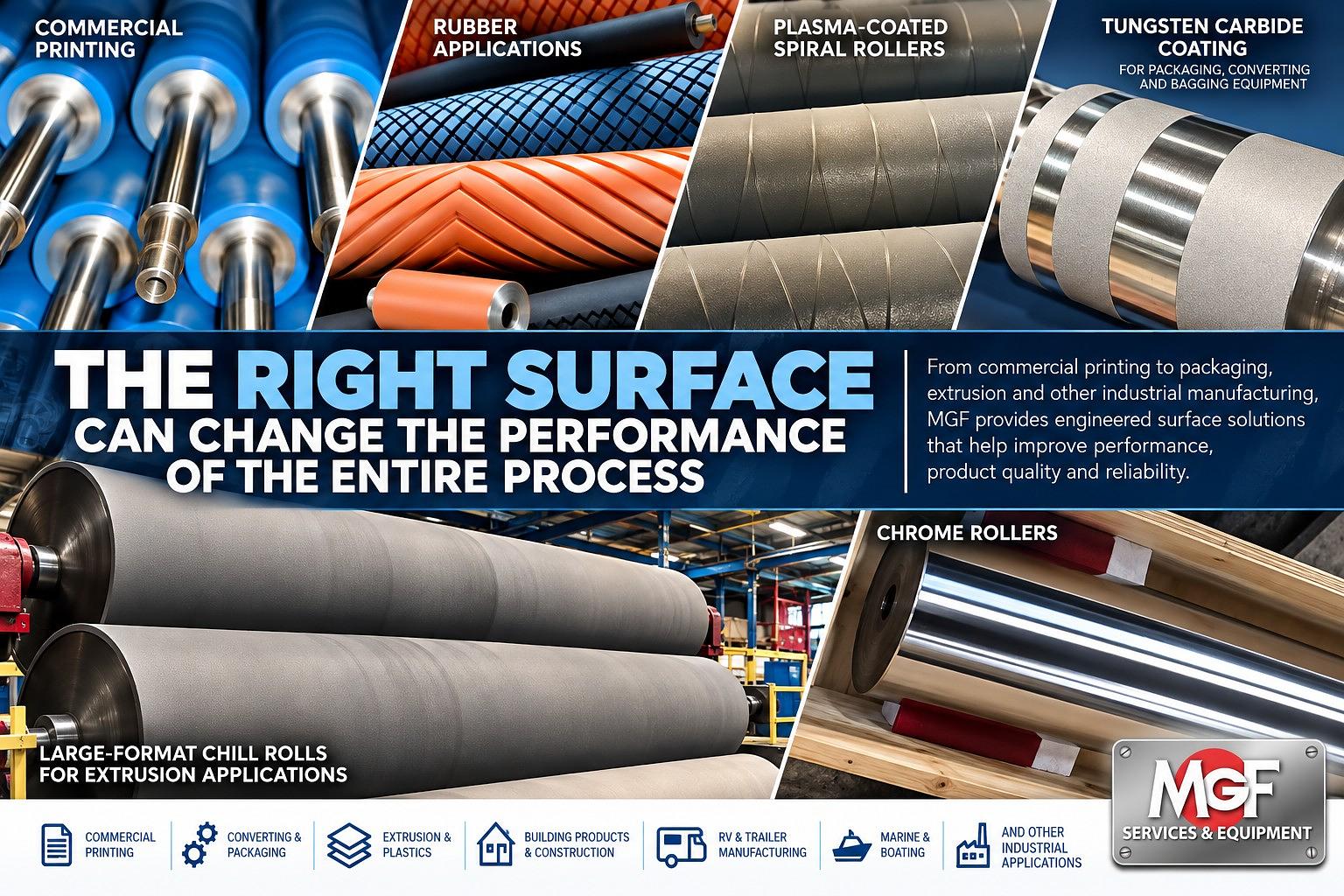
The Right Surface Can Change the Performance of the Entire Process
Published:
When evaluating a roller, it’s easy to focus on dimensions, material, or whether an existing surface needs to be repaired or replaced.
But there’s another question that can be just as important:
What does the surface actually need to do?
At MGF Services & Equipment, we approach roller coatings and engineered surfaces from the standpoint of the application. The correct surface isn’t simply a protective layer applied to a roller. Depending on the process, it can affect traction, release, wear resistance, material transfer, temperature management, web handling, surface texture, and ultimately the quality and consistency of the finished product.
That’s why two rollers that may appear similar can require very different surface solutions.
Surface Performance in Commercial Printing
Commercial printing remains an important part of MGF’s experience, and it’s a good example of just how many different jobs a roller surface may be expected to perform.
Applications can include idler rolls, spreader rolls, squeeze rolls, anilox rolls, ink fountain rolls, water transfer rolls, knurled rolls, draw rolls, and other specialized press and finishing components.
Each has its own operating requirements.
A surface may need to provide the proper traction without damaging the web. Another may require specific release characteristics. Some applications depend on wear resistance or consistent material transfer, while others require a particular surface finish or dimensional tolerance.
The important point is that there is no single “best” coating or surface for every roller.
The best solution is the one that matches the application.
Beyond the Printing Press
The same principles apply well beyond commercial printing.
MGF also supports roller and surface applications used in other manufacturing environments, including companies supplying products for RV and trailer manufacturing, manufactured housing, residential and commercial building products, and marine and boating applications.
These processes can introduce an entirely different set of operating requirements.
One example involves chill rolls used as part of an extrusion process.
In this type of application, we’re not simply asking whether a roll needs to be recoated. We need to understand what happens during production.
What operating temperatures will the surface experience?
What type of release characteristics are required as the material moves through the process?
Does the application require a particular surface texture?
Is there an engineered or random pattern involved?
And importantly, does the roller surface itself contribute to the characteristics or appearance of the finished product?
When the answer to that last question is yes, the surface isn’t just supporting the manufacturing process—it has become an integral part of it.
Temperature, Release and Surface Pattern Matter
Temperature is one example of why understanding the application is so important.
A coating or surface that performs successfully in one operating environment may not be appropriate when temperatures, materials, pressures, speeds, or other process conditions change.
Release characteristics present another consideration. Depending on the material being processed, the surface must allow the product to separate properly and consistently. The wrong surface characteristics can create production issues even when the roller itself is mechanically sound.
Then there are applications where the surface profile or pattern serves a specific purpose.
In certain manufacturing processes, a smooth surface isn’t necessarily the objective. A particular texture or engineered pattern may be required as part of producing the desired result.
This is where surface engineering becomes much more than simply “recoating a roller.”
Start With the Application, Not the Coating
Customers sometimes come to MGF knowing exactly what coating they believe they need. Other times, they come to us with a roller, a drawing, an existing specification—or simply a production problem they’re trying to solve.
Both are good starting points.
But before determining the solution, we want to understand the application.
What material is being processed?
What is the operating environment?
What temperature range is involved?
What are the release, traction, wear, transfer, or surface-finish requirements?
Is the existing surface performing as expected?
Has something within the process changed?
Those details can help determine whether the existing specification remains appropriate or whether another surface solution should be considered.
One Question Can Start the Conversation
From commercial printing and converting to extrusion and other industrial manufacturing processes, MGF Services & Equipment works with customers to evaluate roller applications and determine the appropriate path forward.
That may involve restoring an existing surface, applying a specialized coating, reproducing a required surface profile, evaluating a different material or coating technology, or developing a solution for a unique application.
The industries and equipment may be different, but our starting point remains the same:
What does this surface need to do?
Because when a roller surface is engineered for the application, it doesn’t simply protect the component.
The right surface can change the performance of the entire process.
If you have a roller or surface application you’d like to discuss—whether it’s a familiar application or something a little outside the ordinary—contact MGF Services & Equipment. We’d welcome the opportunity to review the requirements with you.